Published on March 23, 2026
Rethink at Seven Oaks Farm Delivers Significant Change
At Seven Oaks Farm in North Yorkshire, James Dowkes and his team have just achieved a remarkable 523 eggs per bird over 101 weeks with their first flock of Dekalb White layers. The results are excellent and made even more remarkable because James freely admits they had been struggling with below average to average production with previous flocks of brown birds.
In this article James, and Dan King from Sandhill Vets, reflect on the combination of breed change, management advances and health plan improvements that they believe have combined to make such a difference.
Before changing from brown birds to the Dekalb White, James felt he had tried everything to improve the welfare and performance of his birds, but pecking incidents and mortality remained stubbornly high with production below targets. “We were seeing mortality as high as 12%, with production around 90% and tailing off after 60 weeks,” James explains, “Despite enrichment with good toys and careful litter management, pecking was a problem, and we really thought we had tried everything. Eventually we put it down to too much light coming through the pop holes. The house was south facing, and it’s well known that too much light increases pecking, so we painted the pop holes black on the underside. Finally, we tested the lighting with a device that revealed a pulsing that was invisible to the naked eye. That led us to invest in new lighting and controllers that allowed a gentler phasing in and out of the lights.”
“In the same year as the new lighting went in, our first flock of Dekalb Whites arrived. Our Joice and Hill Technical Rep suggested that the Dekalb breed had noticeably different traits to the brown birds, were easier to manage and crucially had a reputation for pecking less. We had been with Eggsell from the start, and they are white bird enthusiasts, so we were able to get a white contract. They told us that colour is much less relevant to consumers now. There were also fears that white eggs might command a lower price, but that’s not been the case in my experience.
“The first white flock depleted on 14 January 2026 and we were extremely pleased with the results. The new flock is just starting and they are looking good, with pullets coming in from Noble with good weight and evenness.”
James noticed straight away that the Dekalb White birds like to roost at night. “The first flock went to bed really well with very few floor eggs, they knew where the nest boxes were and they eat less food,” James notes, “They are low maintenance and tick all the boxes. We even put a robot lawn mower into the shed to stop them laying eggs in the corner – but in the end we quickly realised we didn’t need it after all!”
A regime of changes
The lighting and breed changes are only part of the story, as James says, “There is an interesting veterinary story as well. We recently changed to Sandhill Vets and Dan King was charged with doing everything to get the most eggs from our birds.”
At this point, Dan takes up the story, “James put his faith in us, and we began a process of investigations followed by recommendations. We tested bloods and found infectious bronchitis, so an additional in-flock vaccination protocol was added. Mycoplasma gallisepticum was also detected, and a vaccine was put into the rearing regime.
“The next step was increased monitoring, which resulted in putting a bespoke worming plan in place. Then the water lines were sampled which revealed contamination, so water sanitisers were put in place and Hydrogen Peroxide used weekly in-lay, as James says, ‘Before, we were just flushing, but on Sandhill’s recommendation we introduced sanitisers. Put simply, hens should be drinking tap-water-quality water.’”
Dan agrees, “Starting with clean water should be non-negotiable. James has created a piped flush system so they can flush more frequently and for longer. It’s much easier, and each line is flushed once a week. It proves that if something is made easy then it’s more likely to be stuck to.
“Testing for red mite found a moderate level, but as an additional safeguard, the previous flock was treated towards the end of the cycle to support birds in late lay and minimise the incidence in the incoming flock - as red mite also transmit several pathogens, reducing burdens will help prevent disease transmission from one flock to another. For the first time at Seven Oaks, we are planning to use the Salmonella vaccine again, at 50 weeks. It has recently been licensed as safe to use in-lay and will give extra cover to flocks that are going to 100 weeks. This is particularly important here because there are also pigs at Seven Oaks Farm,” he explains.
James is delighted by the pro-active approach of Sandhill Vets, “Each small change adds up to better results and shows how having a rethink can achieve significant change. We are happy to invest more in to get more eggs,” he says, “since pecking ceased to be an issue, we have had no E. coli septicaemia, meaning this is the first flock that haven’t needed anti biotics,” he adds.
Dan agrees, “As returns are good, people are positive and prepared to invest in treatments and to investigate options to maximise returns. It would have been good to try one thing at a time for James, but the key thing is that it is working!”
Looking back to when egg prices and margins were low, James admits considering putting pigs in the sheds “Eggsell reassured us that good times were on the horizon and as it turns out, they were right, so we are glad we didn’t,” he admits.
Seven Oaks house their birds in one 16,000 flat-deck system, and as there weren’t a lot of whites in flat-deck systems they weren’t sure how long they could keep them, with the main concern being muck. “We committed to keeping the birds to 100 weeks and it wasn’t a problem. Muck is sometimes an issue, but not with Dekalb Whites, in fact, we plan to take the new flock to 106 weeks, and we have no worries,” James says.
By way of summary, James concludes, “The work Dan did with the brown flocks put us in a great place ahead of trialling our first flock of white birds. In addition, the Dekalb birds are low maintenance, and they tick all the boxes. They knew where the nest boxes are, eat less, and we get very few floor eggs. There are no issues with dirty eggs, seconds are low with good shell quality at 100 weeks - in fact seconds were lower than brown flocks at just 70 weeks, and we could have kept the whites even longer.”
When asked about future plans, James replied, “We have got enough work to do for three of us, so we are happy as we are. We did consider investing in a multi-tier shed, but I think we will leave that for the next generation!”
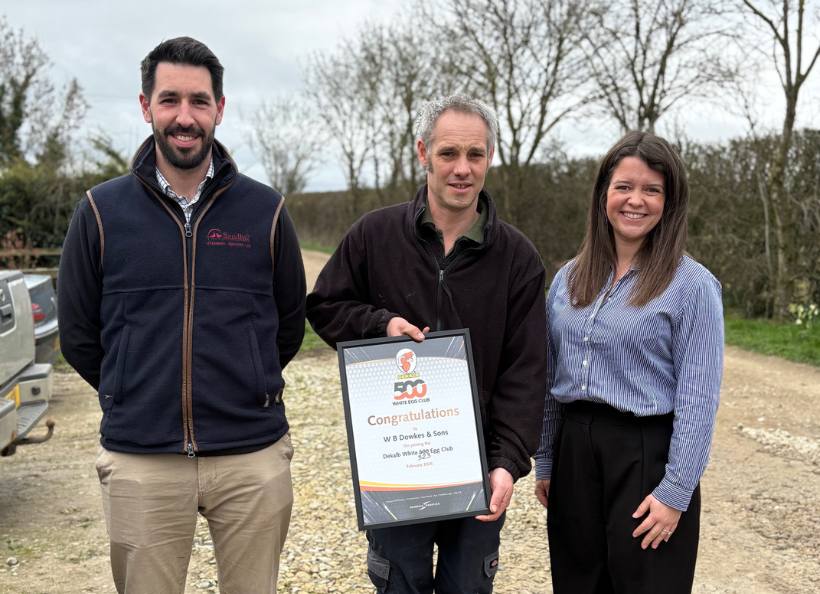
Group Photo left to right: Dan King, James Dowkes and Jordan Bullman.