Published on Oct. 19, 2026
Harrisons Farms: The Journey to a Record-Breaking 575 Eggs Per Hen Housed
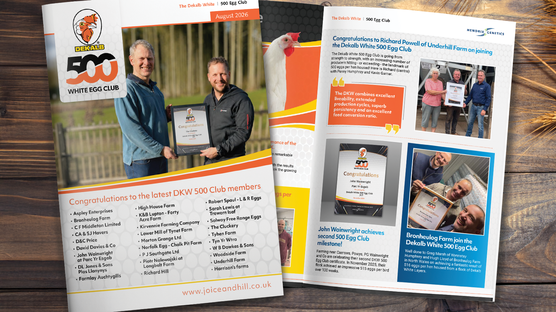
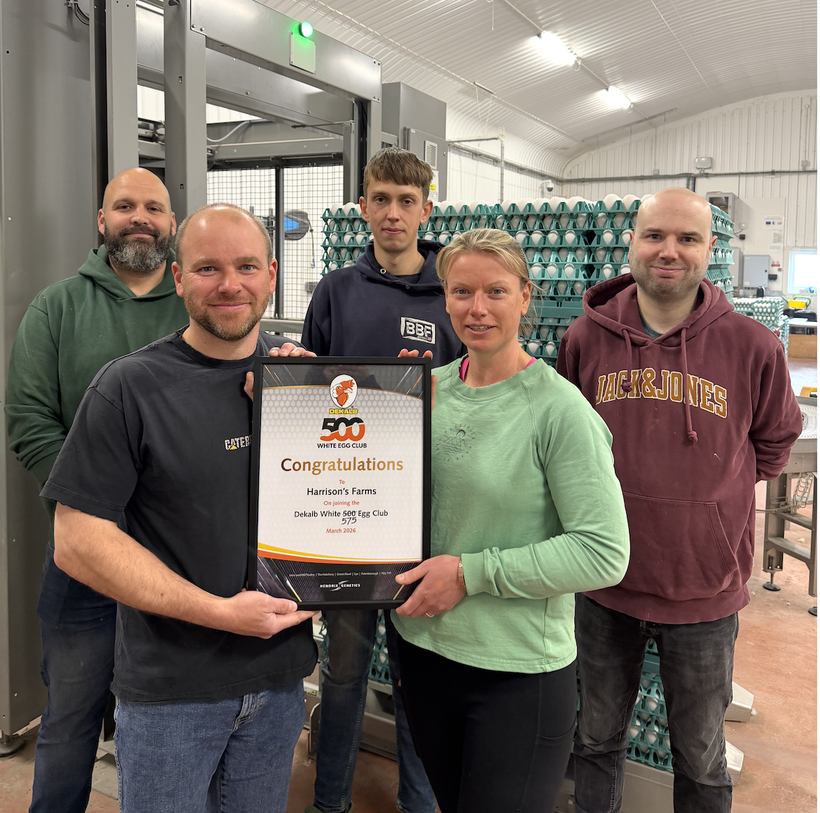
When Harrisons Farms depleted a free-range flock at 108 weeks with an average of 575 eggs per hen housed, it marked an exceptional achievement by any standard. The result earned the North Yorkshire business membership of the DKW 500 White Eggs Club, recognising performance from a flock of Dekalb White layers that exceeded expectations and set a new benchmark.
A Family Business with Poultry in its DNA
Harrisons Farms is a fifth-generation family farming business, operated by siblings Chris and Shell Harrison in partnership with their parents. The family has farmed at its current North Yorkshire location since 1966, although poultry has been part of the family's story for much longer.
“While Dad was growing up, small-scale egg production was very much part of the mix,” explains Chris. “Gran and Grandad reared day-old chicks to point of lay, managed laying hens and sold eggs locally alongside the arable enterprise. But he didn't want to move into cage production when it became the mainstream system. Eventually many smaller producers were squeezed out and so the farm focused on arable, cattle, sheep and potatoes.”
However, both Chris and Shell always intended to return to farming after completing their education. Chris studied agriculture at Askham Bryan College, while Shell's interest in poultry began much earlier.
“Poultry has always been a passion,” she says. “I love being amongst the birds. I was selling eggs for pocket money when I was at school - balancing hockey, school and chickens!”
As the next generation looked towards the future, it became clear that diversification would be essential to create a sustainable business capable of supporting multiple family members.
“At that time, around 2010, free range was really starting to take off,” says Chris. “Consumers and retailers were increasingly recognising the importance of welfare, and we could see opportunities developing within the sector.”
Building for the Future
Before making the leap, the family invested significant time researching the industry.
“We travelled all over the country, and in Europe, visited several farms and spoke to multiple producers,” recalls Chris. “All four partners were involved in the decision-making process, and we all shared our thoughts before we committed to poultry.”
The first free-range unit was anything but conventional. Housing 16,000 birds in a multi-tier Vencomatic Bolegg system, it was a bespoke shed, designed by Chris and developed in collaboration with a local builder.
“I enjoy designing and building,” says Chris. “We had a clear vision of what we wanted, and ended up with a higher-quality shed, tailored to our needs, for the same money as an off-the-shelf option. We were focused on creating an environment that would support bird health and long-term performance.
“We raised the roof to improve air volume and ventilation and incorporated 12 inches of insulation in the roof and 9 inches in the walls,” says Chris. “This helps maintain stable temperatures in hot and cold weather, creating a more consistent environment for the birds.”
A second 16,000-bird shed followed, again incorporating Big Dutchman equipment, before a third house for 32,000 birds was constructed in 2017 using Big Dutchman equipment.
Welfare First
Throughout the farm's development, one principle has remained constant.
“Everything we do is focused on the hens and keeping the girls happy!” says Shell.
For the Harrisons, welfare is not a separate goal; it is the foundation of productivity. Healthy, happy birds are more resilient and productive, enabling them to sustain strong performance over longer laying cycles.
Their record-breaking flock certainly supports that philosophy. Depleted at 108 weeks, the Dekalb Whites maintained excellent persistency while continuing to deliver the egg quality required by the market.
“We have to supply a quality product that the packer can sell,” says Chris. “There is always a balance between pushing birds further and maintaining quality. We were very happy with 108 weeks, but perhaps 110 weeks will be the target in future.”
A Game-Changing Move to White Birds
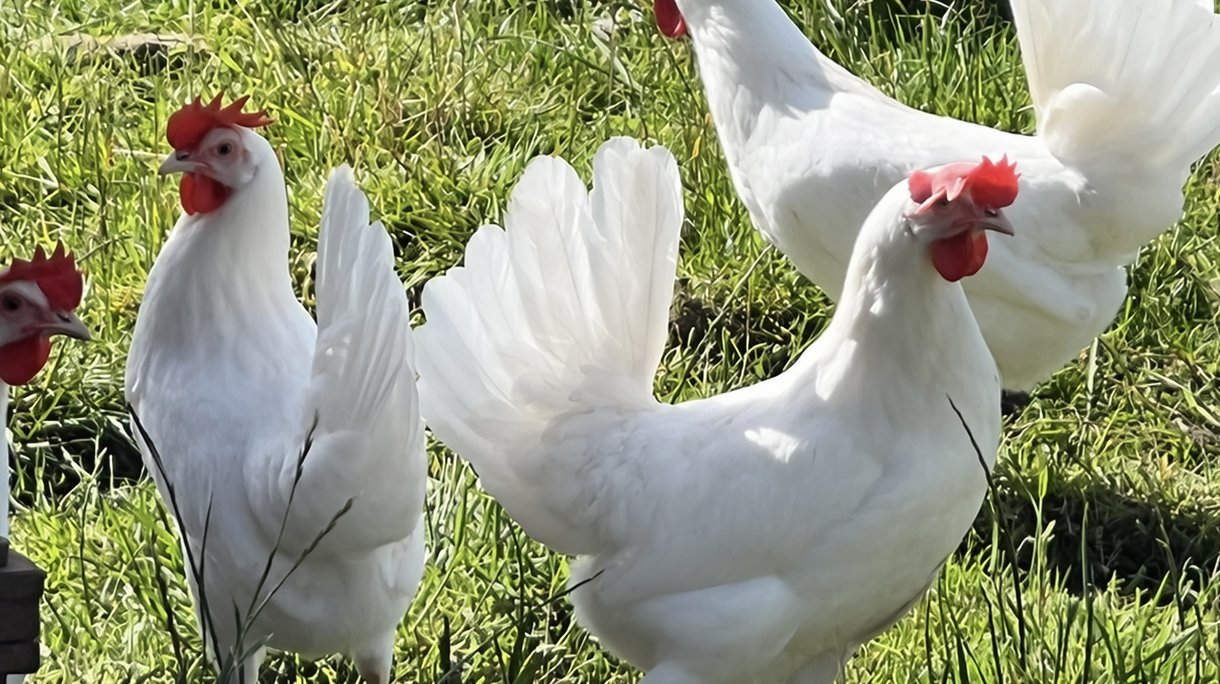
The record-breaking flock was also notable because it represented Harrisons Farms' first experience with white layers.
Over the years the farm had worked with several brown layer breeds, including Lohmann, ISA Warren and H&N birds, supplying several packing organisations. However, a conversation with Anglia Free Range Eggs prompted the family to consider a move to white egg production.
“Anglia put a proposal to us based on white eggs” explains Chris. “We did our research and felt it was a great opportunity. It was right at the start of white eggs becoming more visible in supermarkets and gaining traction in the market.”
The Harrison family selected Dekalb White, the white layer breed from Hendrix Genetics, hatched in the UK by Joice and Hill. The results exceeded even their own expectations.
“White birds were game changers,” says Shell. “We've really enjoyed the change and the different characteristics the Dekalbs have brought. It's been a very positive move”.
Behind the figures lies a philosophy built on attention to detail, continuous improvement, sustainability and, above all, a genuine passion for poultry welfare.
“We absolutely smashed it with the first flock,” says Chris. “But success comes from a combination of factors. The birds must have the genetic potential, but management, nutrition, housing, welfare and the whole team must come together to allow that potential to be realised.”
The family quickly reordered the breed in 2025. “As soon as we realised what they were capable of, we reordered,” says Chris. “The current flock is performing very well and at 29 weeks of age is achieving 98% production.”
Beyond egg numbers, the Harrisons have been impressed by the breed's feed efficiency, ease of management and overall consistency. “Previous flocks of brown birds already achieved very good feed conversion figures, but the white birds have taken performance a step further.”
While white eggs required some minor packing adjustments, Chris notes that concerns around shell quality quickly disappeared. “White eggs can be slightly less forgiving from a handling perspective, so we made some small changes. But the shell quality is every bit as good as brown egg, and overall seconds are lower.”
Sustainability Through Self-Sufficiency
A defining feature of Harrisons Farms is its determination to reduce reliance on external inputs and market volatility. Renewable energy forms a major part of that strategy. Through a combination of solar and wind generation, the business currently achieves around 85% energy self-sufficiency. “We're installing battery storage now, which should take us beyond 85% self-sufficiency,” says Chris.
Feed is another area where the family has focused on maximising control. The business grows its own cereals, utilising a mobile milling unit from Peter Rhodes Feed Services, and working closely with Premier Nutrition to formulate rations - creating what Chris describes as a circular economy.
“We like being able to make incremental changes to diets. Feed control is one of our strengths. It’s rewarding to follow the entire cycle—from growing and harvesting the cereal to drying it and feeding it to the birds,” says Chris.
The record-breaking flock were fed a low-soya ration throughout the cycle. “We're proud of feeding the birds on a sub-10% soya diet,” says Chris. “The record-breaking white flock finished at just 6% soya, which is very low compared with industry norms. Overall average feed intake average was only 110g per bird per day.”
Chasing Marginal Gains
The Harrison family readily acknowledges that there is no secret formula behind their success. “We believe in doing the basics well,” says Chris. “The key is constantly looking for marginal gains.”
Central to that philosophy is a culture of openness and collaboration. The farm works closely with its advisers and shares performance information in real time. “We question everything, we're very open with our data. We have a WhatsApp group where advisers can see how flocks are performing and help us with proactive advice. We like taking them on the journey with each flock,” says Shell.
The same willingness to innovate is now driving an interest in artificial intelligence.
“We're exploring AI because we're confident it will identify patterns we might not recognise ourselves,” says Chris. “Whatever AI has to offer, we want to be part of it.”
A Team Effort
Despite the impressive records and industry recognition, the Harrisons remain firmly focused on the people behind the achievement. “The DKW 500 Club certificate was the cherry on top,” says Chris. “It was nice to get the recognition, and it was good for the team.”
That team is committed to the farm's vision and has been instrumental in its success. “We couldn't do it without them. They've really bought into what we're trying to achieve.”
As Harrisons Farms looks ahead, the goal remains unchanged: producing eggs efficiently, sustainably and responsibly while ensuring the highest standards of bird welfare.
The remarkable achievement of 575 eggs per hen housed demonstrates what is possible when outstanding genetics are matched with exceptional stockmanship. The Dekalb White flock may have delivered the record, but it was the Harrison family's unwavering focus on welfare, sustainability, teamwork and continuous improvement that created the conditions for success.